Calculate the perfect watering schedule for your trees in less than 30 seconds — built with the science our certified arborists use every day.
The difference between a thriving canopy and a dying tree is rarely disease — it’s usually water. Done right, it’s the simplest investment you can make.
Slow, deep watering encourages roots to grow down, not just near the surface, which helps trees handle dry spells.
Soil that stays soggy can starve roots of oxygen and encourage root problems. More water isn’t always better.
A tree’s needs change through the year. Summer heat, spring growth, and winter dormancy each call for a different approach.
Six quick inputs. One precise, science-backed schedule.
Cooler temperatures mean less water is lost to evaporation, and the soil has time to absorb it before the day heats up.
A slow trickle from a hose or a drip line soaks down to the root zone. Fast, shallow watering mostly runs off or stays near the surface.
Most of a tree’s absorbing roots are spread out under and beyond the canopy, not right at the trunk. Aim at the area under the outer edge of the branches, which is called the drip line, rather than against the trunk.
Push a long screwdriver or small trowel several inches into the soil near the tree. If it goes in easily and the soil is damp, wait. If it’s dry and hard, it’s time to water.
A 2–4 inch layer of mulch helps hold moisture and keep soil cooler. Keep it a few inches back from the trunk so it doesn’t trap moisture against the bark.
Short, frequent lawn watering often doesn’t reach deep enough for tree roots. Trees usually need a separate, deeper watering.
During extended dry, unfrozen periods, newly planted trees and evergreens may still need occasional watering. Don’t water frozen ground.
How much: –
Run time: –
How often: –
Tip: –
This is a general estimate, not a guarantee. Weather, species, soil, sun, wind, and how your trees are irrigated all change what a tree needs. If your tree looks stressed, an arborist can assess it in person.
Large trees have more complex needs. Treat this number as a rough baseline and consider an in-person evaluation.
Summers in the Treasure Valley are hot and dry, and soil types vary from heavy clay in some areas to lighter, well-drained soils in others. That means two properties just a few miles apart can have very different watering needs.
If your property uses irrigation, check when your system is turned on and off for the season, and whether it actually reaches your trees. Trees that depend on lawn irrigation may need extra watering when the system is off.
Not sure whether your tree is getting the right amount? A tree health evaluation looks at the whole picture: soil, roots, canopy, and signs of stress.
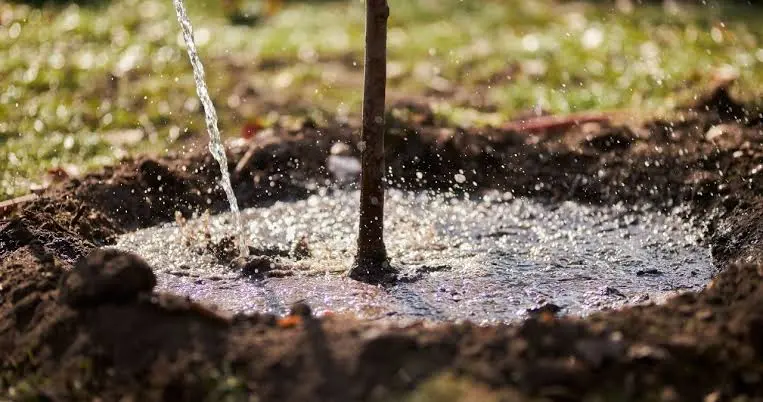
New trees usually need more frequent watering while their roots establish, often for the first one to two growing seasons. Use the calculator for a starting estimate and check the soil before each watering.
Soggy soil that doesn’t drain, yellowing leaves, and fungus at the base can be signs. Check the soil several inches down before watering again.
Often, they do so during hot, dry stretches or droughts, since lawn irrigation may not be enough. A deep, occasional soaking is usually better than frequent light watering.
It gives a general starting point. Species, age, and conditions vary, so treat the result as a guide
Fast emergency response available anytime for emergency tree services.
Fill out the form below and we’ll take care Of the rest.